APSU alum Hannah Richards becomes Vanderbilt’s first Schmidt Science Fellow
By: Colby Wilson April 21, 2026
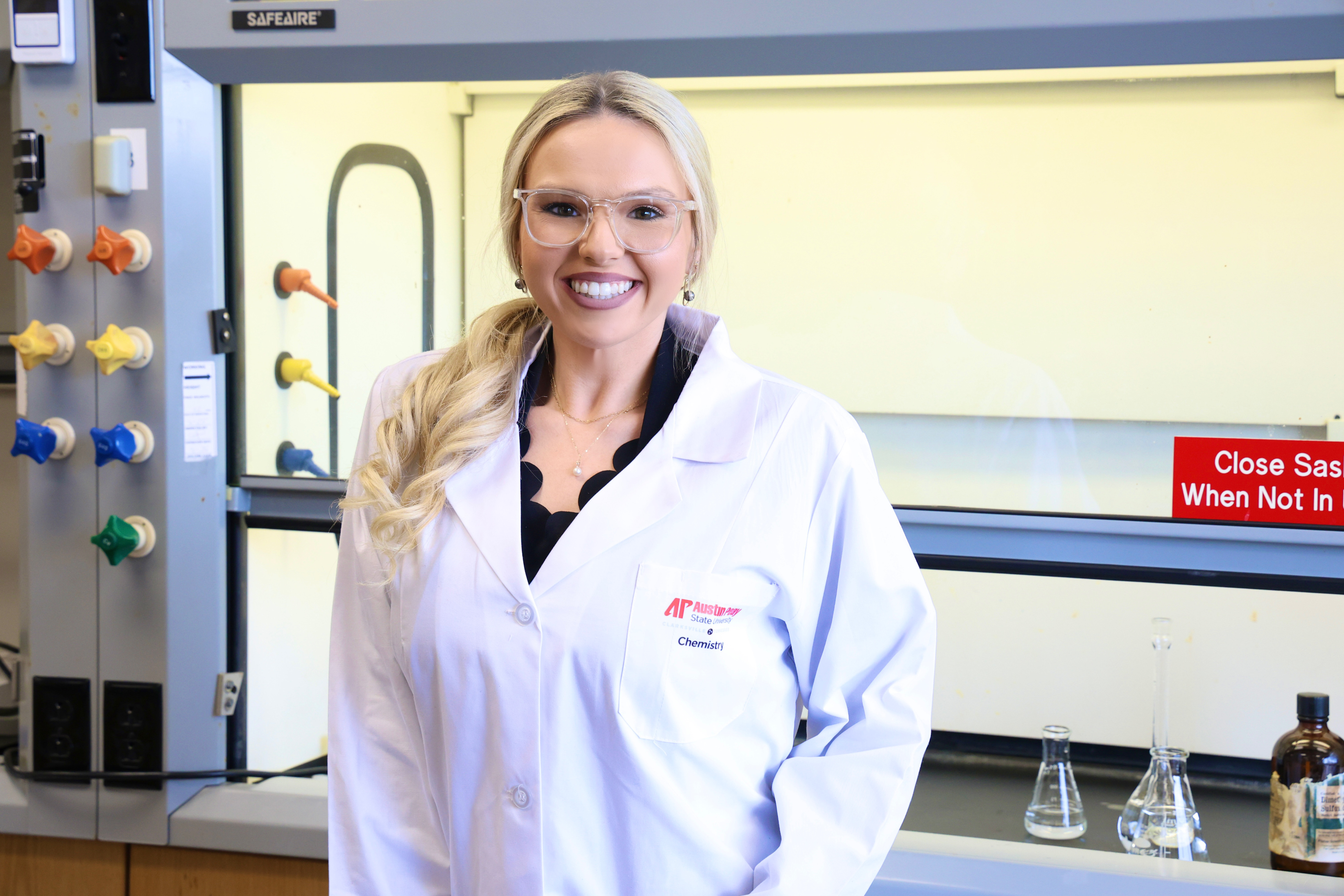
Hannah Richards, an Austin Peay State University chemistry alum and Vanderbilt University’s first Schmidt Science Fellow. | Photo by Colby Wilson.
CLARKSVILLE, Tenn. — When Hannah Richards first declared chemistry as her major at Austin Peay State University, she was "100% confident" she would change it.
â€Àá put down chemistry because I ·É²¹²õ²Ô’t going to put down what everyone else put »å´Ç·É²Ô,â€� Richards said. “â¶Ä˜W´Ç³¾±ð²Ô don’t do chemistry. People from Sumner County don’t often do chemistry.’ I didn’t know what else to put. I figured I was going to change it anyway and then … I realized I love chemistry.â€�
That decision to be different has led Richards to become Vanderbilt University's first-ever Schmidt Science Fellow — one of the world's most prestigious post-doctoral fellowships funded by the Schmidt Fellowship Foundation.
The competitive fellowship supports about 30 global recipients each year and will fund Richards’ research into fungal infections affecting leatherback sea turtle populations. She will work at Florida Atlantic University’s Marine Science Laboratory starting in July, bridging her analytical chemistry expertise with marine conservation.
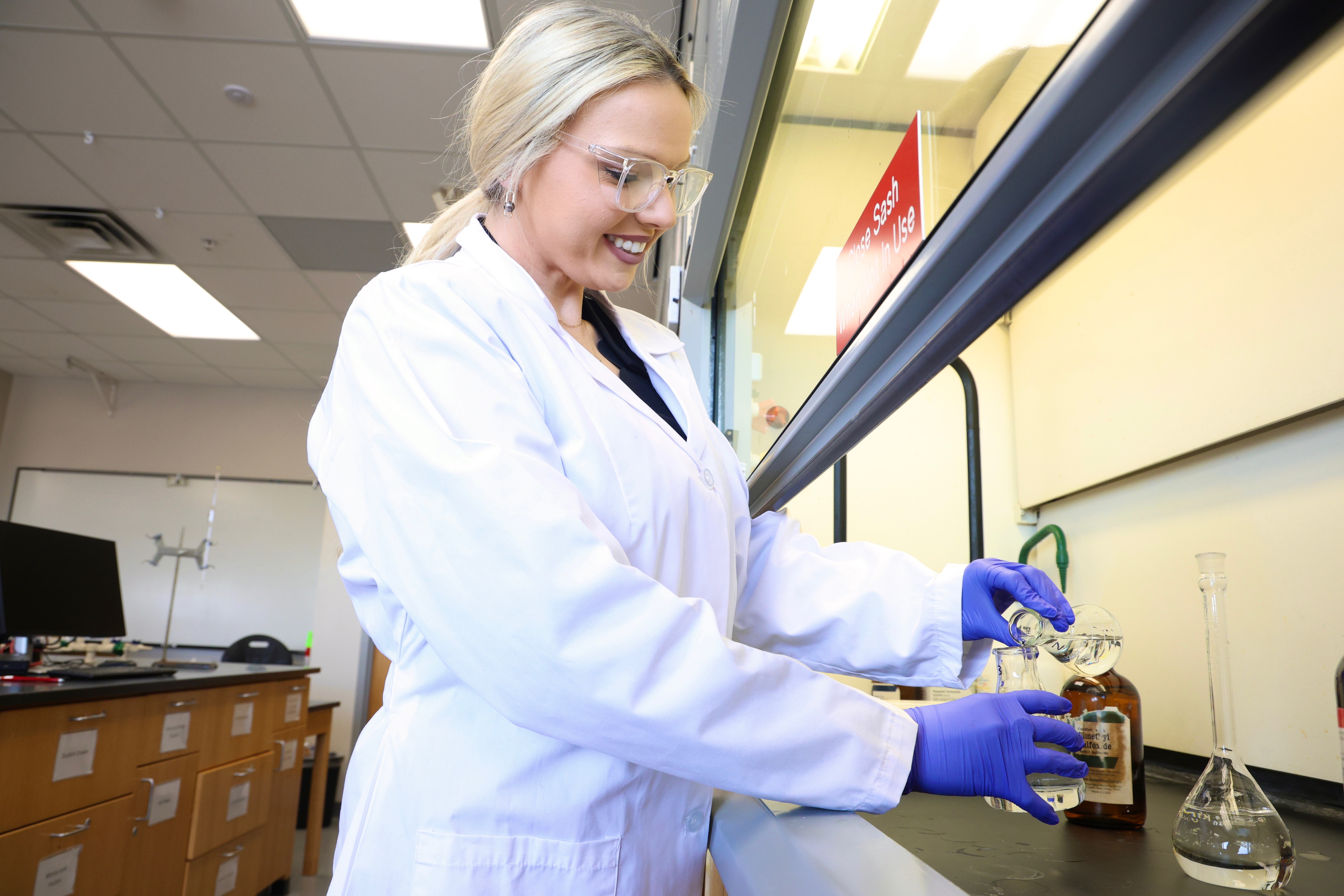
Richards spent her junior and senior years at APSU immersed in lab work and credits its intensive chemistry program for helping her become the first person in her Vanderbilt cohort to graduate within four years. | Photo by Colby Wilson
Building the Foundation at Austin Peay
Richards' path to success wasn't traditional. As a first-generation college student, she had no roadmap for higher education.
"I did not know what a doctoral degree was when I entered Austin Peay," she said. "I didn't think about the possibility until instructors in the chemistry department said I should think about going to grad school."
Her study methods were unconventional. While classmates took notes on paper, Richards wrote everything on thousands of index cards, allowing her to study constantly.
"I would walk around with these huge stacks of index cards," she said. "So I was constantly absorbing everything I learned in class."
The approach paid off spectacularly. In organic chemistry, she earned a 103 on an exam that her professor said looked "like it was written out of a textbook" — though Richards emphasizes her chemistry prowess didn't come naturally, and she received her share of 75s on Physical Chemistry II exams.
Despite excelling academically, Richards faced challenges beyond the classroom. People often underestimated her, sometimes focusing on her appearance rather than her capabilities.
"People would think I was a fashion and design major," she said. "Some scholars have looked at me and said, 'There's no way.' That pushes me even more because I have that 'let's defy the odds' mentality."
Austin ±Ê±ð²¹²â’s impact on Richards extended beyond academics, and she said the faculty members prioritize their students’ well-being.
"My professors told me, 'If you want to be successful in the future, you have to get a grasp on your mental and physical health first,'" Richards said. "They value their students on a personal level. I wouldn't be here without Austin Peay."
With support from APSU's Boyd Health Services and understanding professors, Richards focused on herself as well as her studies. She pursued chemistry with enthusiasm, spending her junior and senior years immersed in lab work. She earned the American Chemical Society-certified degree, requiring additional research and physics — a pathway she likened to "honors chemistry" designed for students heading to graduate school.
The Leap to Vanderbilt and Beyond
Richards credits Austin Peay's rigorous chemistry program with preparing her for success at Vanderbilt, where she is the first in her cohort to graduate in four years.
"Learning how to study early on at Austin Peay changed everything for me," she said.
Her fellowship research represents another leap into uncharted territory—marine conservation work is a new direction for someone from just outside landlocked Nashville.
"I'm essentially just bridging fields," she said. "I'm looking at novel therapeutic solutions — whether it's a preventative or post-infection treatment — to help mitigate this invasive fungal infection."
The work addresses a vital conservation issue, as these infections threaten sea turtle egg hatching success. Richards is eager to apply what she learned at Austin Peay to help solve the problem.
â€Àát’s using the skills that I already have to be able to look at something ²Ô±ð·É,â€� she said. â€Àát’s the same mentality I had going from Austin Peay to Vanderbilt. It’s a different space, it’s a little daunting, but I’m excited. People will say, ‘Oh, I can’t believe you’re doing this,’ but it’s not just me. It’s the training I had at Austin Peay, at Vanderbilt. It’s the faith I took with me. It’s my diligence. There’s an army of people who supported me to get to this ±è´Ç¾±²Ô³Ù.â€�
Continuing the APSU Connection
Despite her new fellowship taking her to Florida, Richards plans to maintain her connection to Austin Peay, where she always seeks opportunities to stay involved.
â€Àá love teaching the students who are sitting in the same seats I once sat in,â€� she said. â€Àát has nothing to do with adding to a resume. My heart will always be with Austin Peay.â€�
As Richards prepares for her next chapter, she remains committed to the principle that guided her undergraduate decisions: there's always a way forward, even when others say there isn't.
"Where there's a will, there's a way," she said. "I look at some of the scholars who have come before me, and some of the most renowned scholars had no defined path. That inspires me to continue onward, because I don't have to follow anyone else's footsteps. I'm creating my own path."
About the Austin Peay College of STEM
The College of Science, Technology, Engineering & Mathematics (STEM) provides studies for students in the areas of agriculture, astronomy, aviation sciences, biology, chemistry, computer science, earth and environmental sciences, engineering physics, engineering technology, information technology, mathematics, medical laboratory sciences, radiologic sciences, and physics. Its outstanding, discipline-based programs are student-centered and designed to prepare students for responsible positions at all levels of research, industry, education, medicine, and government.